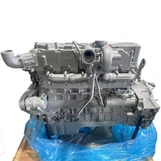
Hey there! As a supplier of Komatsu diesel engines, I often get asked about the nitty - gritty details of these powerhouses. One of the most crucial components in any diesel engine, including those from Komatsu, is the crankshaft. So, let's dive right in and explore what the crankshaft design of a Komatsu diesel engine is all about.
First off, what does a crankshaft do? In simple terms, it's like the heart of the engine's mechanical system. The crankshaft takes the up - and - down motion of the pistons and turns it into rotational motion. This rotational motion is then used to power the vehicle or equipment that the engine is installed in.
Komatsu diesel engines are known for their durability, efficiency, and high performance. And a big part of that comes down to the well - thought - out design of the crankshaft.
Material Selection
Komatsu uses high - quality materials for their crankshafts. Usually, they opt for forged steel. Forged steel has excellent strength and toughness, which is essential because the crankshaft has to withstand a whole lot of stress. During the combustion process, the pistons are forced down with a tremendous amount of force. This force is transferred to the crankshaft, and if the material isn't strong enough, the crankshaft could crack or even break.
The forging process also gives the crankshaft a grain structure that follows the shape of the part. This is important because it enhances the mechanical properties of the crankshaft, making it more resistant to fatigue. Fatigue failure can occur over time due to repeated stress cycles, and Komatsu's choice of forged steel helps to prevent this.
Geometric Design
The geometric design of the Komatsu crankshaft is carefully engineered. It has several key features that contribute to its performance.
Journals
The journals are the parts of the crankshaft that rotate in the engine block's main bearings. Komatsu designs these journals with precise diameters and surface finishes. A proper surface finish is crucial because it reduces friction between the journal and the bearing. Less friction means less wear and tear, which in turn leads to a longer lifespan for both the crankshaft and the bearings.
The diameter of the journals is also optimized. A larger diameter can increase the load - carrying capacity, but it also adds weight. Komatsu engineers find the perfect balance to ensure that the crankshaft can handle the loads while keeping the overall weight of the engine in check.
Crankpins
The crankpins are where the connecting rods attach to the crankshaft. They are offset from the main axis of the crankshaft, which is what allows the up - and - down motion of the pistons to be converted into rotational motion. Komatsu designs the crankpins with a specific offset and size. The offset determines the stroke of the engine, which affects the engine's displacement and power output.
The size of the crankpins is designed to handle the forces transmitted by the connecting rods. These forces can be quite large, especially during high - load operations. Komatsu ensures that the crankpins are strong enough to prevent bending or shearing under these forces.
Counterweights
Another important aspect of the Komatsu crankshaft design is the use of counterweights. The pistons and connecting rods have mass, and as they move up and down, they create an imbalance in the engine. This imbalance can cause vibrations, which not only make the engine run less smoothly but can also lead to premature wear of engine components.
Komatsu adds counterweights to the crankshaft to balance out these forces. These counterweights are strategically placed to counteract the inertia of the pistons and connecting rods. By reducing vibrations, the engine runs more smoothly, which improves fuel efficiency and reduces noise.
Lubrication
Proper lubrication is essential for the crankshaft's operation. Komatsu designs the crankshaft with oil passages. These passages allow oil to flow to the journals and crankpins, providing a lubricating film between the moving parts.
The oil not only reduces friction but also helps to cool the crankshaft. During operation, the friction between the crankshaft and the bearings generates heat. If this heat isn't dissipated, it can cause the materials to expand and potentially damage the engine. The oil flowing through the passages helps to carry away this heat, keeping the crankshaft at a safe operating temperature.
Impact on Engine Performance
The well - designed crankshaft has a significant impact on the overall performance of the Komatsu diesel engine.
Power Output
As mentioned earlier, the offset of the crankpins determines the engine's stroke. A longer stroke can increase the engine's displacement, which generally means more power. Komatsu can adjust the crankshaft design to optimize the power output for different applications. For example, engines used in heavy - duty construction equipment might have a different crankshaft design compared to those used in smaller vehicles.
Fuel Efficiency
The reduced friction due to the precise journal design and proper lubrication helps to improve fuel efficiency. When there's less friction, the engine doesn't have to work as hard to overcome it. This means that less fuel is burned to produce the same amount of power.
Durability
The high - quality materials, proper geometric design, and effective lubrication all contribute to the durability of the crankshaft. A durable crankshaft means a longer - lasting engine. Komatsu diesel engines are often used in demanding environments, and a reliable crankshaft is essential for keeping the engine running smoothly for years.


Examples of Komatsu Engines
Let's take a look at some specific Komatsu engines and how their crankshaft design plays a role.
The Komatsu SAA6D102E - 2 Diesel Engine is a popular engine used in a variety of applications. Its crankshaft is designed to provide a good balance of power and fuel efficiency. The material selection and geometric design ensure that it can handle the loads associated with its power output while keeping the engine reliable.
The Komatsu SAA6D114E - 3 Construction Engine and the Komatsu SAA6D114E - 3 Diesel Engine are used in heavy - duty construction equipment. These engines require a crankshaft that can withstand the high loads and rough operating conditions. Komatsu's design of the crankshaft in these engines focuses on durability and high - load capacity.
Conclusion
In conclusion, the crankshaft design of a Komatsu diesel engine is a complex and well - engineered aspect of the engine. From the material selection to the geometric design, every detail is carefully considered to ensure high performance, durability, and efficiency.
If you're in the market for a Komatsu diesel engine or need replacement parts, I'd love to have a chat with you. Whether you're looking for a specific engine like the ones I mentioned above or just want to learn more about how the crankshaft design can benefit your application, don't hesitate to reach out. We can discuss your requirements and find the best solution for you.
References
- Komatsu Diesel Engine Technical Manuals
- Automotive Engineering Textbooks on Engine Design