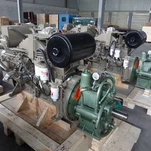
In the field of marine propulsion, range directly determines a vessel's operating radius, operational efficiency, and economy. The design of the engine's intake system is one of the core factors affecting range. The 6LTAA8.9-M300, as Dongfeng Cummins' main 8.9L marine main engine, employs a turbocharged + air-to-air intercooling design. This design doesn't simply pursue power increases, but rather optimizes intake air quality and balances power and fuel consumption to create a highly efficient power cycle suitable for long-term voyages, fundamentally extending the vessel's range.
I. Turbocharging: The Core of Exhaust Gas Energy Recovery and Intake Air Density Optimization
Marine main engines generate a large amount of high-temperature exhaust gas during navigation. Traditional naturally aspirated engines simply emit this exhaust gas directly, resulting in energy waste, while limited intake air volume leads to incomplete fuel combustion. The 6LTAA8.9-M300's exhaust bypass turbocharger's core function is to achieve secondary utilization of exhaust gas energy and precise increase in intake air volume, laying the foundation for optimized range.
II. Intercooling Design: Overcoming the Heat Effect of Turbocharging and Enhancing Range Stability
During turbocharging, the compressed air experiences a rapid temperature increase (typically 50-100°C). This high-temperature air not only reduces density (offsetting some of the turbocharging effect) but also exacerbates the engine's thermal load, increasing the risk of knocking. This forces the engine to increase fuel injection to cool down, indirectly increasing fuel consumption. The 6LTAA8.9-M300's air-to-air intercooling design specifically addresses this issue, creating a synergistic effect with the turbocharger.
III. Synergistic Design: Adapting to Marine Operating Conditions and Extending the Range Limit
The 6LTAA8.9-M300's turbocharger and intercooler design are not simply superimposed; rather, they are deeply adapted to the characteristics of long-term continuous marine operation and large fluctuations in operating conditions, ultimately achieving a comprehensive improvement in range.
In summary, the turbocharger + intercooler design, through the complete logic of "exhaust gas energy recovery - intake air density improvement - combustion efficiency optimization - thermal load control", not only solves the contradiction between power and fuel consumption of traditional marine main engines, but also adapts to the complex working conditions of the ocean, ultimately achieving a substantial improvement in the ship's range. This is also the key reason why this design has become the core configuration of medium and high power marine main engines.