

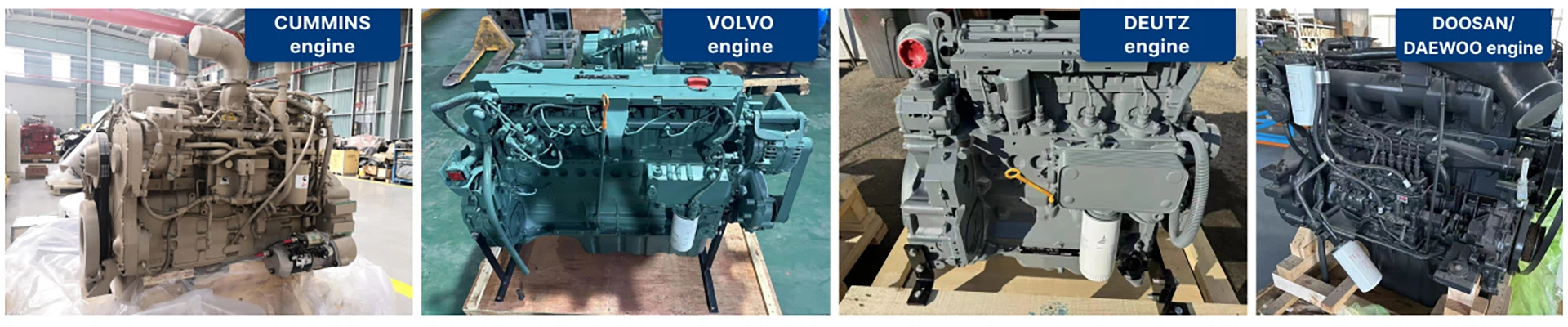
Introduction: A Technological Benchmark for Modern Industrial Power
In the global industrial power sector, engine selection directly impacts equipment operating efficiency, operating costs, and long-term reliability. The Doosan DL08 series engine, a prominent representative of modern diesel power technology, has become the preferred power solution for numerous industrial sectors due to its superior performance and wide applicability. This article will delve into the analysis of this highly favored power core from three aspects: technical characteristics, application advantages, and key selection points.
I. Core Technologies: Technological Innovations of the DL08 Engine
1.1 Advanced Combustion System Design
The Doosan DL08 engine employs a fourth-generation high-pressure common rail fuel injection system, achieving injection pressures exceeding 2000 bar. Combined with an optimized combustion chamber structure, this ensures complete fuel atomization and efficient combustion. This design not only improves combustion efficiency but also maintains excellent fuel economy under partial load conditions.
1.2 Intelligent Electronic Control Management System
The engine is equipped with a fully electronic control unit (ECU), which monitors operating parameters in real time and automatically adjusts injection timing, injection quantity, and boost pressure. The intelligent control system features adaptive learning capabilities, optimizing operating strategies based on changes in the operating environment to ensure the engine is always in optimal working condition.
1.3 Innovative Thermal Management Technology
The DL08 engine utilizes a staged cooling system design, precisely controlling the temperature of the cylinder head, cylinder block, and turbocharger separately. This innovative thermal management solution effectively reduces heat load, improves engine reliability, and shortens cold start time by more than 30%.
II. Performance Advantages: Six Core Competencies of the DL08
2.1 Superior Fuel Economy
By optimizing the combustion process and improving mechanical efficiency, the DL08 engine reduces fuel consumption by 8-12% compared to its predecessor. In practical applications, this advantage translates into significant operating cost savings, especially in continuous operation scenarios.
2.2 Outstanding Reliability
The engine is constructed using high-strength materials, and key components such as the crankshaft and connecting rods undergo special heat treatment processes. After rigorous testing, the DL08's overhaul interval can reach over 15,000 hours, providing long-term stable power assurance for equipment.
2.3 Wide Power Range
The DL08 series offers a variety of power configurations from 75kW to 147kW, with different tuning schemes to meet diverse needs. The engine delivers smooth torque across a speed range of 1000-2200r/min, offering excellent adaptability.
2.4 Excellent Environmental Adaptability
For harsh operating conditions such as high temperature and high altitude, the engine is equipped with an adaptive intake system and fuel compensation function, maintaining rated power output at an altitude of 3000 meters and an ambient temperature of 50℃, with a power attenuation rate of less than 5%.
2.5 Comprehensive Emission Compliance
The DL08 series offers configuration options that meet various emission standards, from China III and Euro IIIA to Euro V. Through advanced in-engine purification technology and after-treatment system combinations, it achieves an optimal balance between emission performance and fuel economy.
2.6 Optimized Maintenance Convenience
The modular design of the DL08 engine makes maintenance and repair more convenient. The replacement time for easily worn parts such as oil filters and fuel filters is reduced by an average of 40%, significantly reducing equipment downtime.
III. Application Guide: How to Select the Most Suitable DL08 Configuration for Your Equipment
3.1 Determine Application Scenario Requirements
Before selecting the DL08 engine, you need to clarify the following:
Working cycle characteristics (continuous operation/intermittent operation)
Typical load characteristics (constant load/variable load)
Operating environment conditions (temperature, altitude, humidity)
Emission regulations
3.2 Power Matching Principles
Proper power matching is crucial for ensuring long-term reliable engine operation:
Main generator: Select based on continuous power (PRP), with a recommended load rate of 80-90%.
Construction machinery power: Select based on power requirements under common operating conditions, considering peak load requirements.
Backup power: Select based on emergency power (ESP), paying attention to allowable overload time and frequency.
3.3 Configuration Selection Recommendations
Depending on the specific application, the DL08 can be equipped with:
Different specifications of cooling systems
Cold start auxiliary devices suitable for low-temperature environments
Special protective configurations such as dustproof and moisture-proof
Customized control and monitoring interfaces


