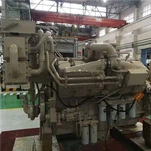
In the field of power selection for small and medium-sized vessels (200-800 gross tons), displacement adaptability directly determines the vessel's operational efficiency, maintenance costs, and compliance capabilities. The 8.3L engine in the Dongfeng Cummins 6CTA8.3-M220 has become the preferred power source for mainstream small and medium-sized vessels such as fishing boats, inland waterway cargo ships, and government patrol vessels because it precisely matches the industry's core requirements of "controllable power redundancy, optimal fuel efficiency, and controllable maintenance costs," rather than simply stacking parameters.
Firstly, the 8.3L displacement achieves a "golden match" between power output and vessel load. The core operating scenarios for small and medium-sized vessels include near-shore fishing, heavy-haul inland waterway transportation, and shallow water operations. These vessels require sufficient power to handle sudden loads (such as the instantaneous thrust of fishing boats trawl and cargo ships passing through shallow waters) while avoiding the power waste caused by large-displacement engines being "overpowered." Industry selection data shows that the 8.3L engine offers over 30% faster power response in complex sea conditions compared to smaller displacement engines of the same power, while fuel consumption only increases by 5%-8%, achieving an optimal balance between power and energy consumption.
Secondly, the 8.3L engine's structural design is well-suited to the maintenance and space constraints of small and medium-sized vessels. These vessels typically have compact engine rooms and limited maintenance conditions (mostly near-shore or inland waterway operations with scarce professional maintenance resources). This necessitates engines with simplified structures, low failure rates, and easy maintenance. The 6CTA8.3-M220 employs an integrated cylinder block design, reducing the number of parts by 25% compared to similar products, significantly decreasing the number of potential failure points and meeting the operational needs of small and medium-sized vessels for "low maintenance and long range."
Thirdly, the 8.3L displacement aligns with the industry's emission reduction transformation and globalization requirements. With the International Maritime Organization (IMO) continuously tightening emission reduction regulations, small and medium-sized vessels, as a key area for emission reduction in the shipping industry, face the dual pressures of "compliance upgrades" and "cost control." The 8.3L engine of the 6CTA8.3-M220 utilizes a high-pressure fuel injection system, improving combustion efficiency by 15% compared to traditional models. Its nitrogen oxide emissions meet European and American Tier 3/Stage IIIA standards, eliminating the need for complex exhaust gas treatment devices, thus reducing equipment procurement costs and subsequent maintenance burdens.
In summary, the 8.3L displacement has become the "golden displacement" for small and medium-sized vessel power because it accurately addresses the industry's needs in three core areas: power matching, maintenance costs, and compliance adaptation. Through technological optimization at this displacement, the 6CTA8.3-M220 solves the fundamental problems of "sufficient power, fuel efficiency, and maintenance difficulty" for small and medium-sized vessels, while also aligning with the global trend of emission reduction transformation in the shipping industry. This is the core logic behind its long-term dominant position in this segment.